

Our final day in Iceland was one of surprises – all of which were far milder in magnitude than the ones that disintegrated the first half of our week into days of waiting for the snowstorm to calm, were happy little ones, nuggets of Icelandic magic that fed our mounting unwillingness to leave this extraordinary land.
Bessastaðir
Surprise number one struck early in the morning. We had barely set out from Reykjavík when our guide stopped our car in the middle of a field. Here, out beyond the inlet Skerjafjörður that lined the city’s rugged coastlines, stood a cluster of red-gabled buildings and a small church. The Icelandic presidential residence.
No plaques or ornate gates marked its political and historical significance. I was struck by its plainness, its openness – a telling reflection of Icelandic governance, perhaps? As I traipsed around the property, childlike in my sense of freedom, I spotted a lone Icelandic flag off to its side, rippling in the bracing cold.
Kleifarvatn
Surprise number two followed quickly enough. We sped past the city perimeters, and everything happened at once – winding roads unfurled into ice-sheathed fields, dramatic peaks jutted up like claws from the earth in front of our windows and just like that, we were in the unbridled, wild terrain of the Reykjanes peninsula, barely half an hour from the heart of the capital.
I caught my breath. I wanted everything to stop. Our car, speeding much too fast through stretches of unspeakable beauty. Time, steering us much too soon towards our inevitable departure. This earth, this beautiful, shifting land and the spreading rift between its tectonic plates, splitting Iceland apart, transforming its geological terrain in infinitesimal ways every second.
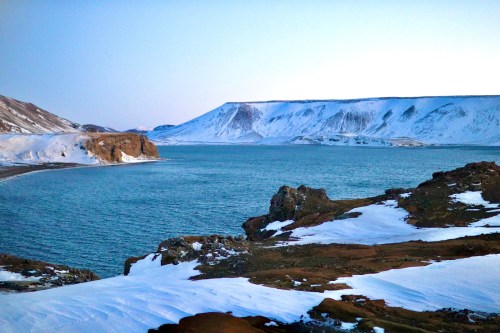
While not all of these transpired, I was relieved when the car stopped at the edge of a volcanic lake. That was when my second wish came true.
The waters of Kleifarvatn lake run old and deep like the sky. They stand guarded by tuyas – subglacial volcanoes with horizontal beds of lava on their tops – and are swaddled in a cold, clear stillness. I found myself edging towards a cliff that straddled the lake, small steps on a vast rock. Here, there was no vestige of passing time or movement. Only a fullness of soul and a slow burning of my face, as Kleifarvatn unspooled below me, an ageless, unmoving lake.
Grindavik
Our third surprise had come in the form of a detour, thanks to shifting weather and road conditions. We were dropped off in yet another field of snow – I will probably never find a plain white canvas boring again since it will forever invoke the many snowy fields of this country – and directed to walk towards the edge.
Somewhere behind us, sulphuric plumes billowed out of the ice. As we made our way up an abutment, the wind gave way to something else – clamouring waves and salty-sweet air and bubbles of snow and mud. We had reached the coast.
To the east, tides crashed into cliffs. Water spilled from deep gashes within the ice into rivulets, pooling into a small lagoon above the sea. A lone tern screeched and took flight above the volcanic coast.
There was ice, there was water and then there was the golden sky – all children of the same mother. I peered across the lagoon, once again willing with every cell in my body for the earth to stop breathing, for the oceans to pause.
“Lived here all my life,” our guide had told us on our lunch break an hour ago. He had joined us at the top floor of a cafe in Grindavik village that overlooked the whale harbour, a grey food hall that reeked of wet rope and fishing nets, where the stews were hot and the cheeses sharp. “Always wanted to go to the islands. All my life I haven’t been able to fathom why people would flock to this boring old place.”
I looked up from my food.
“I mean,” he continued, swirling his spoon in his chowder. “It’s all white and grey and blue anyway.”


 the mythsmith
Leave a comment